Monday, 28 January 2013

Thoughts on cognitive self-diagnosis, or How Can We Reduce Student Drop-Outs?

Finding the time to write and post these blogs is proving tricky!  I wanted to write something of a follow-up to my previous post on the interesting UK-based Medical Diagnostics company, who developed a simple and cheap widget for rural African villagers to self-diagnose their HIV immunity levels.  


The concept of patients ‘lost to care’ which their device helps reduce is the equivalent in the education sector of student ‘drop-outs’ - except I suspect the consequences of not receiving medicine are probably more threatening in the short-term and result in more fatalities.

Meeting these two gents has got me wondering: what would the educational equivalent of this immunity diagnostic test be? Could one imagine a widget that would allow self-administered diagnosis for learning deficiencies? Would it have the same impact? 

One problem I can immediately identify with my own whimsical educational widget is that learning is not binary, and while there are aspects of cognition that lend themselves to either/or diagnostics (can you resolve a quadratic equation or can’t you? Do you or do you not remember who invaded England in 1066? Can you or can you not change a spark plug or a nappy in under twenty seconds?)  the more interesting questions are open-ended and to do with forming critical connections, reapplying theories and what is loosely called creativity (e.g. what were the causes of the second world war? How would you predict the winner of the next election? Are the Millennium Development Goals helpful or harmful? etc).

Answers to the former category of binary learning tests would simply inform the curious educational ‘patient’ that, no, they didn’t have the recall or hard knowledge about solving quadratic equations or William the Conqueror but it wouldn’t necessarily tell them why they couldn’t remember or why these particular facts or skills are relevant or important.  Answers to the latter kind of question could be interesting to read but there would be so many it is hard to imagine how a cheap and self-administered diagnostic tool would realistically cover them all.

In some sense, most villagers who carry a mobile phone do have access to a widget with great processing power and educational potential.  What is clever about the medical diagnostic widget is that the fool-proof but complicated blood-based chemical tests that happen within the white plastic box, tell the patient simply 'Treat' or 'Don't Treat'.  This basically means 'get to hospital ASAP' or 'don't worry, you've got a bit more time to live'. Brutal, but effective. 

Some series of quick-fire tests (maybe subsidised phone calls with a volunteer teacher or coach, maybe some response SMS texts that test basic literacy or basic arithmetic) could potentially serve the same function: if you can't answer this, or read this, or compute this within a certain time threshold - GET YOURSELF TO SCHOOL/COLLEGE/SKILLS TRAINING. 

The problem I now see is that the motivational pressure that is at work within the medical diagnostic isn't quite so acute when applied in the educational self-testing; people failing the educational diagnostic don't have impending death to focus their immediate actions on getting to a school.  What might be needed would be some accompanying information that conveys to the educational 'patient' all the benefits that accrue when you remain in school - e.g. how much more income they might make, how much better their livelihood skills would be (these already seem too trite and theoretical, and not as punchy as 'you're about to die!').  Accurate diagnosis followed by quick remedial cognitive results might yield better results.  This is how the 'master-a-skill-get-a-reward-by-gaining-access-to-a-new-level' pyschology underpinning certain computer games operates - and it effectively keeps gamers playing for hours!  This could in effect be turned into some form of conditional cash transfer scheme - paying students via the mobile phone as they progress through more and more sophisticated levels of competencies.  10 cents for every series of 10 Maths questions you get right in a row.  1 full dollar if you get 100 questions right, and can show sustained competency on a similar test 3 months later...maybe even a real book gets posted to you when you complete all levels!

I haven't figured this one out yet.  I do sense there will be something out there to do with technology and self-study and appropriate motivational structures that could shift the dial somehow to tackle the enormous drop-out rates across SSA.   Any suggestions please do comment and let me know your thoughts...

Friday, 11 January 2013

Aid-funded business trip in Kenya and Uganda


For two weeks in late November and early December 2012 I was part of the UK’s Trade and Investment ‘aid-funded business’ delegation which took me first to Nairobi, Kenya to meet the large donors (World Bank, Department for International Development, African Development Bank, United Nations Family) and then on to Kampala, Uganda (to meet the same folks, with more of a UN focus).  The idea was that the twelve or so UK SMEs represented by our motley crew would be able to find out more about the not-particularly-straightforward way these donors procure business, and we would all, in some way, benefit by increasing UK exports.  

I’m only now just getting round to posting this note, which is inspired by two new friends I made whilst on the trip – the CEO and his long-time Director of a UK based health medical diagnostics company called Omega Diagnostics. 

This company has been in existence for 25 years and produces (in Scotland and a couple of other regional sites in England) niche diagnostic health equipment, for use particularly in sub-Saharan Africa.  

My two new friends were showcasing a specific product called CD4, which was essentially a small white rectangular box about the size of my finger. CD4 is used to test a patient’s blood sample, and simply requires a tiny finger prick blood sample which is processed right then and there within 45 minutes. After the chemical magic has taken place, a simple ‘treat’ or ‘don’t treat’ message appears, telling a patient whether their immunity levels have decreased beyond a critical threshold, and therefore whether they need to seek out HIV retro-viral medicine.   

The product is brilliant because it is sold for less than $5 USD per unit, is simple to use and portable, is diagnostically definitive, and the results following the test are easy to understand for the patient.  If you are a villager in a remote part of Africa you can now test yourself with a CD4 box, without having to walk ten miles to a regional hospital for a trained nurse.  Villagers with HIV can self-monitor regularly and affordably, and will now be able to move quickly to obtain antiviral drugs the moment the test shows their immune levels dropping beneath a certain critical level.   

What’s very clever I think about Omega’s approach is that they have picked an area of real medical importance, thought about the everyday barriers that patients in Africa tend to face (long walking distances, no transport), and combined the science and technology and manufacturing know-how to solve this puzzle.  Commercially they have first-mover advantage – they tell me there is no other company in the world which currently produces such a health kit diagnostic. The chemistry behind the diagnostic test was developed by an Australian Laboratory and Omega worked with them and provided the IP and facilities to help scale production. Omega is now in the Sales phase, approaching donors specifically interested in reducing AIDS HIV to buy this kit. Pharmaceutical companies see it as an advantage because for a very small amount of upfront subsidy cost they can get patients onto the much more expensive retro-viral drugs.  CD4, if it’s taken up by donors and used in the way it is intended to be, should basically help reduce the numbers of patients lost to care (which is sadly, I’m told, still very high across Africa). There are still an estimated 33m people with HIV in Africa, (quite likely to be an underestimate).  

It pleases me to think of scientific and manufacturing innovation like this coming out of the UK, and I wonder if Omega Diagnostics is the shape of companies to come as globalisation increases and our world gets smaller; relatively small numbers of highly specialised employees, collaborating with others in Australia, manufacturing in the UK and in India, and distributing and targeting customers in Africa.  I’m not at all prone to giving stock tips but Omega is actually listed on London’s AIM, so anyone who wants to invest in Omega can do so.  I believe you’d be investing in a company that has its heart in the right place and is in a very good position to help reduce the some of the considerable suffering caused by AIDS. If only more companies could be like this, and if only more donors would take the time to actually attend travelling business delegation meetings and hear what is actually out there in the marketplace. 

Tuesday, 11 September 2012

Philippines: Taxi Diaries (1)

"Parents in the  Philippines are wholly focused on their children getting a College degree."

I am in a cab driving to Manila airport. It's now become my habit to quiz taxi drivers about their children in whichever country I'm in. By asking after their children I generally can dig deeper into what kind of school they attend, where they might go after school, what the impressions are of the teachers etc. It all adds colour to my understanding of local education conditions and how the primary purchaser (a parent) perceives the product (schooling).

Ray is my chatty, smiley driver tonight (I think almost every Filipino I've met this week has beamed with smiles - a delightful phenomenon that is quite unusual after London). I estimate Ray is in his late forties. The nuggets he tells me are assembling into a narrative that I suspect is typical for many millions of Filipinos. Ray's story then goes as follows.

Ray was born in the rural Provinces. His father (now passed away) was a farmer who hadn't attended school. Ray himself went to primary school and left after grade six. Ray took a conscious decision as a young man to migrate to the capital city to increase his earnings power. As far as I can gather Ray's last formal involvement with education was the driving license test he took in 1988 just before he first started driving his cab.

Ray and his wife have three children: two sons, and the youngest, a daughter. All three are currently attending college (or have just graduated). The children are studying Information Technology, Business Management and Computer Science at a public university in Manila.  The eldest son has just begun a job at a call centre. "The pay when you start is OK, around 17,000 pesos per month (c.USD $400), it but gets better as you stay," says Ray, "it's tough for him since he sometimes begins work at 3am, and sometimes at 1pm." Ray appears, quite rightly, quietly proud of his son's employment and the prospects now open to his other two kids. One of them is already earning, I estimate, 3-4 times more than his father.

Ray's children have achieved what I believe some social development geeks call Single Generation Transformation. From rural farming grandparents, via Ray's urban migration and serious hard graft, the grandchildren are all now college educated and ready for skilled employment within the service industries. Education has clearly been a major driver in bringing about this transformation - a free public school system, a fast growing economy, huge parental sacrifice and constant pressure on the kids to strive for self-improvement are all wrapped up in this. This is what it means I suppose to move from "low income" country status to a "middle income" category.  I wonder how long Ray's kids will remain working within Manila, before the lure of Hong Kong, Dubai, or Korea takes them abroad like so many of their compatriots (someone told me this week that 15% of the Philippines' total GDP derives from remittances sent by overseas workers).

When I ask Ray about his experiences of schooling his children, he tells me that "of course I am a driver and my children went to government school. Private schools here are very expensive - 50,000 pesos per semester." Interestingly, when quizzed about what kinds of quality standards his children's school exhibited, Ray shrugs his shoulders and says non-committally "it's OK." It occurs to me that my question is somewhat crass; when free government provision is all that is within reach, there is no real choice over quality standards.

The other interesting nugget is that even government schooling isn't totally free. Ray says "miscellaneous fees cost about 5,000 pesos a year...my son took a jeepney (public bus) every morning and afternoon to school and back, that's 30 pesos per day, plus text books and materials."

When I ask Ray about whether he's ever thought about pursuing any further studies for himself he laughs it off, "life is tough, I must drive."

When I ask Ray about whether he ever thinks about returning to his family home in the Provinces, he pauses; "yes, maybe I will, when all the children are taken care of and have good jobs.  There is no money in the Provinces, but I can farm." I can't tell if it's my romanticising temperament or something genuinely felt by Ray, but I think I detect a hint of nostalgia flicker in Ray's eyes as he utters this.  Work and family may have become so all-absorbing for Ray these last two decades there may have been little time to consider his own future plans.  We have now arrived at the Departures drop-off zone and it's time for me to get out.  I realise I haven't taken a picture of Ray to include with this post, and now wish I had.  I will make sure I take photos of any other taxi drivers I happen to write about in future. 

Philippines 2: Public School Visit

During my week in Manila, I visited two government schools also in the district of Mandaluyong. The trip was kindly facilitated by the Department of Education.   Below I include some photos and commentary from what we saw.

School number one was actually an elementary school, and we only went around briefly.  We arrived after lunch in what was a very active school break, with swarms of children playing around the halls and courtyard. They were very intrigued to see who the guests were, talking with their Principal.

School Entrance.


Elementary school - playground and classroom blocks

Classroom block - no running in the corridors!

A rather happy student, pleased with sliding down the bannisters and having his photo taken. 

District officer in charge of cluster of Mandaluyong public schools.  Kindly hosted us around the school tours.
The second school we saw was a Senior High school, and is I believe the flagship school within the District (it should be noted therefore that it may not be completely representative of what other urban state secondaries look like, for purposes of comparison to the private school).  We first met with the Principal and she then invited what I think must have been the entire female faculty to join us, as you can see from the photo below:


Yours truly with staff of Gonzales High School.  Principal is the lady immediately left of me.
When quizzed many of the staff had been teaching at the school for between 7-15 years.  All appeared very pleased with their roles and the progress of the children (but then they were all in front of their boss and conducting an official school tour, so I'd hardly expect them to say anything else.) 


The full name of the school is the rather lengthy Mataas na Paaralang Neptali A. Gonzales, and you can visit the school's official website here.  From what I could gather, the late Mr. Gonzales Senior was a politician representing the District in Congress, and he founded the original school using his own money.  His son, also now the current District Congressman, is still sponsoring the school and has recently organised and funded the construction of two new school blocks, adding 80 new classrooms to the facilities.  

Reminders of Messrs Gonzales Senior and Junior were all over the school - both in the golden statue greeting visitors in pride of place in the entrance courtyard, and in the political banners hanging from the school blocks. 


Students just outside the Gonzales school entrance, leaving school after a busy day.

University-esque facade that greets visitors upon entry.


Statue of Congressman Gonzales, Snr, founder of the school.
Dedication Plaque noting that the new Congressman Gonzales has organised the construction of the new school classrooms.
Campaign poster for current congressman hanging in school. 

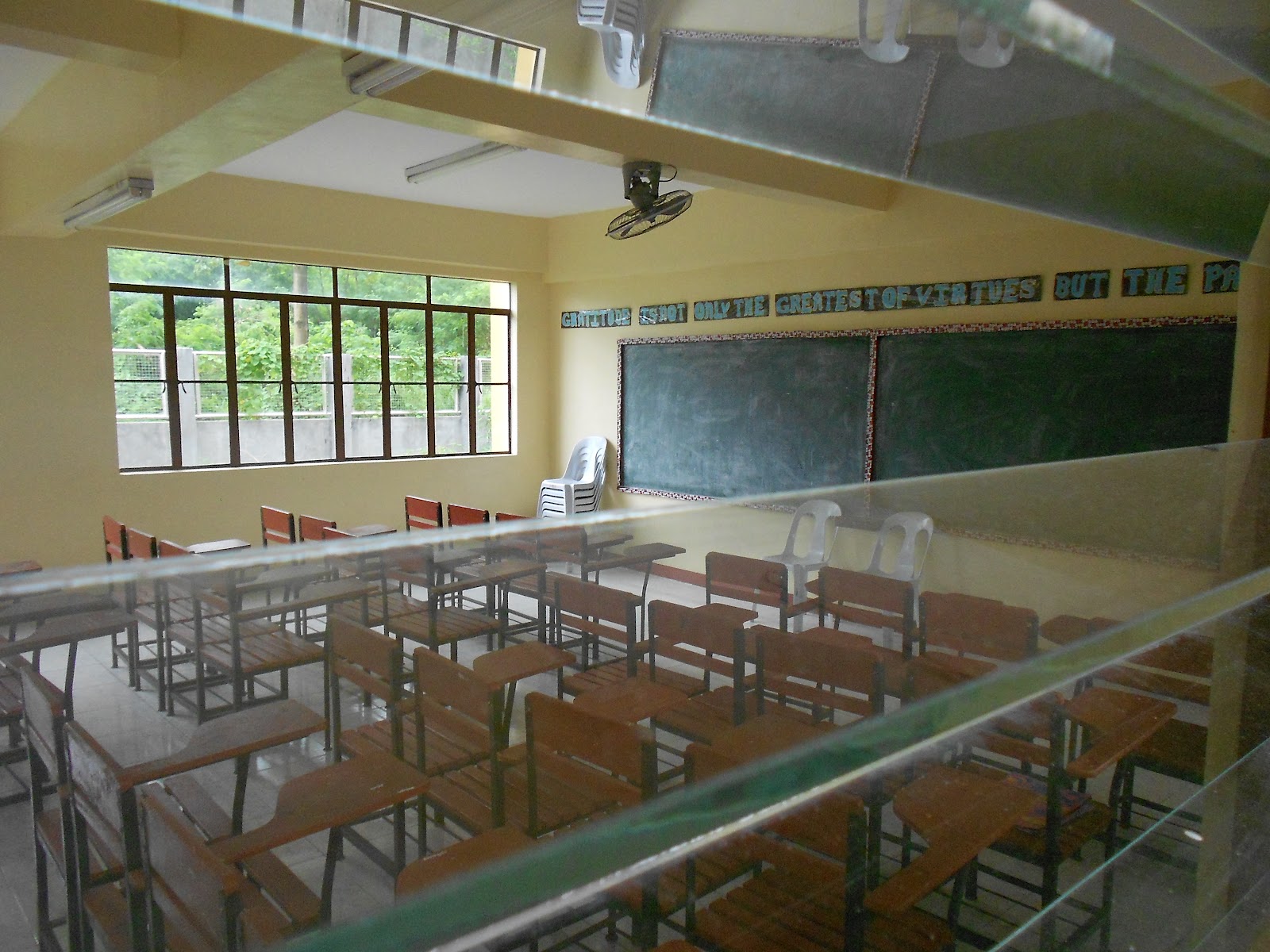
As for the school's facilities themselves, we unfortunately only got to see the empty classrooms.  I counted desks in each classroom, and they had been standardised to 45 students to 1 teacher, lower class sizes than typical for the private school (and certainly for rural state schools).  There didn't appear to be any projectors or educational ICT equipment, but the new classrooms were clean and spacious. 


Grade 7 weekly timetable - school day formally starts at 7am and finishes at 1.30pm. 
One unexpected feature that the Congressman had donated to the school was what was called a 'Practice House.'  It was essentially a stand-alone bungalow domestic residence, with bathroom, living room, and kitchen, in which, so we were told, students could practice 'home economics' and hospitality/domestic cleaning. 

On the one hand this is quite a practical policy to equip students with vocational skills that are clearly in demand out there in the real world.  On the other hand, I worry that encouraging students immediately into professional domestic service is perhaps reinforcing the stereotypical role that foreigners often expect Filipinos to pursue.  It may not be raising aspiration in quite the best way, but we didn't really have much of a chance to interrogate exactly how the Practice House was used, which students got to use it, and how it integrated into the standard curriculum. 


The outside of the Practice House
 

The Principal shows us inside the Practice House.
Another group photo outside the Practice House.
 The school had decent sports facilities, and was clearly relatively well-resourced.  We couldn't get much detail about the student attainment levels or extra-curricular activities, but were reassured that relative to other government schools student performance was strong. 


Gonzales Sports rink for basketball, football, and athletics.


In terms of infrastructure the Gonzales school came across as marginally better than the JRU private school.  The comparison is interesting though, because clearly Gonzales receives considerable formal and informal funding subsidies to help it expand and maintain its good quality infrastructure - I wonder how sustainable those levels of subsidies will be right across the state system, particularly in the poorer rural Provinces?  Much more detailed data will be needed about the inspection reports on each school, the assessment of student performance, parental satisfaction levels, alumni tracking, College and University acceptance rates, and indeed the actual nature of the curriculum and student competencies mastered.  It turns out that not much standardised testing is actually done in the Philippines, and therefore making precisely this quality comparison between private schools and public schools is difficult.  I think the last comparable student performance data available that takes in both types of schools is the 2002 PISA test, but I will have to dig into this. 


Friday, 7 September 2012

Philippines 1: Private School Visit

Last week I was in Manila, doing some work for the Asian Development Bank.  Part of our introductory tour involved going on a school visit, and since one of the chief reasons for me starting this blog was to capture and record some of these school visits, I include some photos and some of my personal impressions below.

The school we visited was a high school called Jose Rizal University High School which is part of the University and College campus complex, offering education right from Elementary level, through High School and into College, University, and Post-Graduate level.   It turns out that it's more common for Higher Education Institutes within the Philippines to diversify upstream, as it were, and run High Schools or younger to help feed the main University or simply as part of a general community building activity.

On the way to school we saw some wonderfully colourful Jeepneys, which are the public buses running around Manila and decorated in idiosyncratic style by their drivers.  We also came across a couple of yellow school buses - I wonder where it was decreed that all school buses in whatever part of the world you're in MUST BE YELLOW?

A Jeepney - notice the strong Catholic flavour!


School bus within JRU's courtyard.


We arrived about 2pm just as afternoon lessons were beginning, and were given a very hearty welcome by the Principal, who informed us that there were about 1,600 students enrolled and about 45 teaching staff.

Outside the Principal's office, a picture board of all 45 teaching staff, organised by subject.  


Yours truly standing with the School Principal.

Office of the VP for Basic Education, round the corner and in same corridor as main University Campus building.

Looking down on self-organised student rehearsal, in the concrete courtyard.

First floor corridor, row of classrooms on the left.

View of School's east wing, and high rise apartment's just opposite school.
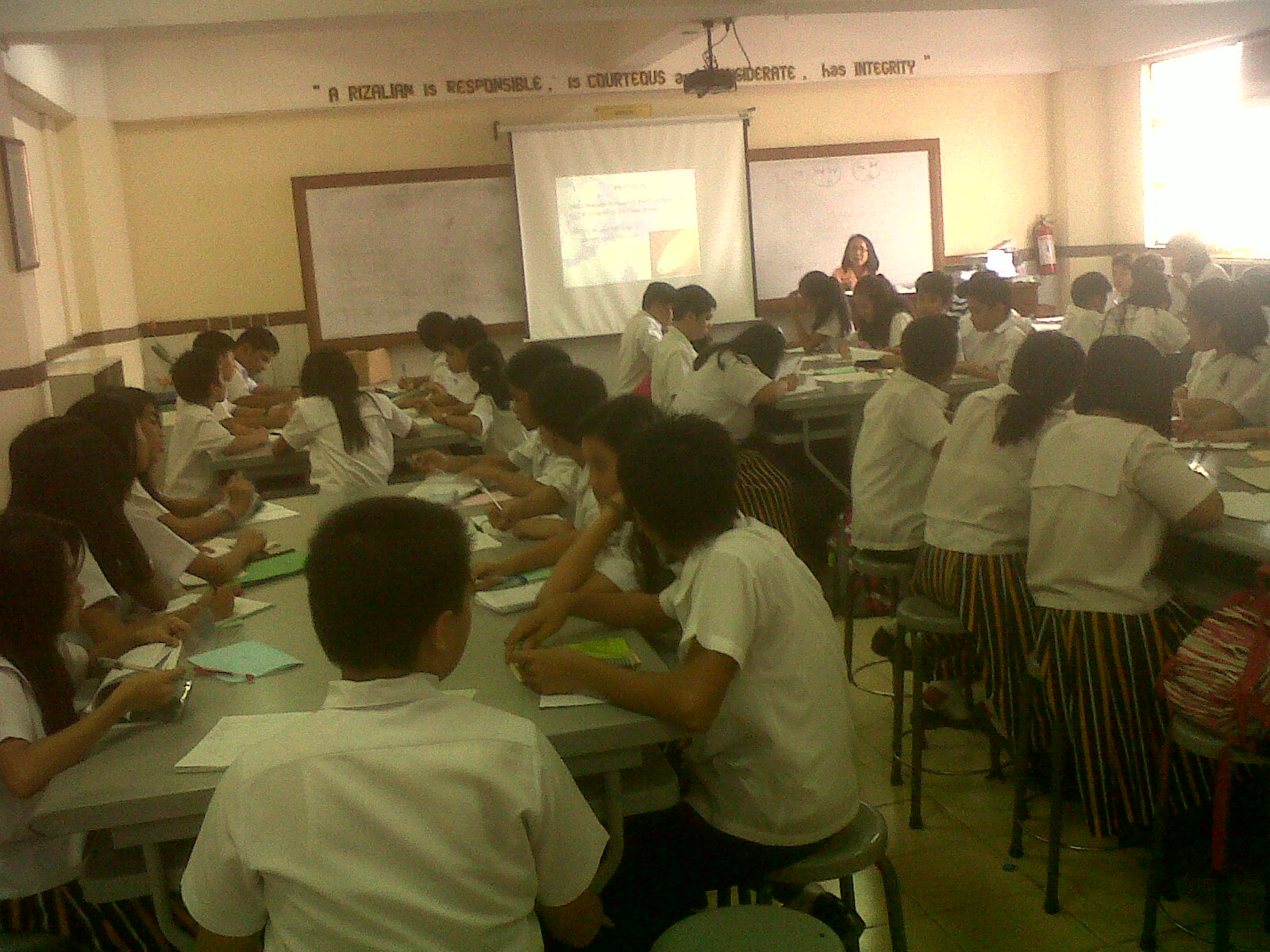
The average class size in the school is around 50 students per teacher.  The few classes we saw did tend to have a teacher at predominantly at the front of the class, with some fairly tightly-pressed students sitting in rows.  Student engagement seemed decent enough, and c.80% of the 25 or so classrooms had projectors and smartboards.

A chemistry lesson in progress - 50 odd students and a smartboard.

Some girls pleased about their Physics Laboratory!


Helpful signs to differentiate which class I'm meant to be going to.


A biology lesson in progress.

School Computer Lab.


One of 3-4 e-monitors mounted by the school staircase or in the hallways, that scrolled information about the day's news, or links to school website, or announcements about lost property etc.  Quite a nifty information system for students.

My general impression was of a well-run school environment where kids appeared friendly and fully engaged.  Two members of staff had been teaching there for 23 years a piece, and their attitude about the school's mission and place in the community was highly positive.   The picture below shows the price range for the primary level students.


It's hard to read, but the picture lists tuition fees at between 18,000 to 22,000 Pesos per student per year (for Grades K to 6 in this case).  That's a remarkable $400-$550 USD per year price point.  We didn't get to see any hard examinations data but were told anecdotally that students did well and the school outperformed some of its local state school competitors.   About 400 of the attending students are part of the government's subsidised Education Service Contract (ESC) scheme, whereby lower-income families can get a student place paid for at a private school up to 10,000 pesos per annum, and then pay a top-up fee to make up the difference.  The scheme was introduced many years ago as part of a policy to reduce the supply-side crunch and pull local private sector schools into the mainstream system.

Another advantage the school has of being part of the University campus, is that it gets access to the shared sports facilities (see below):

School gym.

College students prepare to play basketball.

Part of the large sports hall facility.


JRU High School is planning on expanding next year, and has already identified the parcel of land next door in which the capital works will begin.   I'd very much like to thank all the staff and students who hosted me and my colleagues during the school, and I wish them the best of luck with the expansion plans!

The construction site next door where JRU High School's extension may be built.

A view of the neighbouring streets of Mandaluyong City surrounding the school.  It's an inner-city school within one of the central urban districts of Metro Manila.